Wall Stud Detector Explained: A UK Buyer's Guide
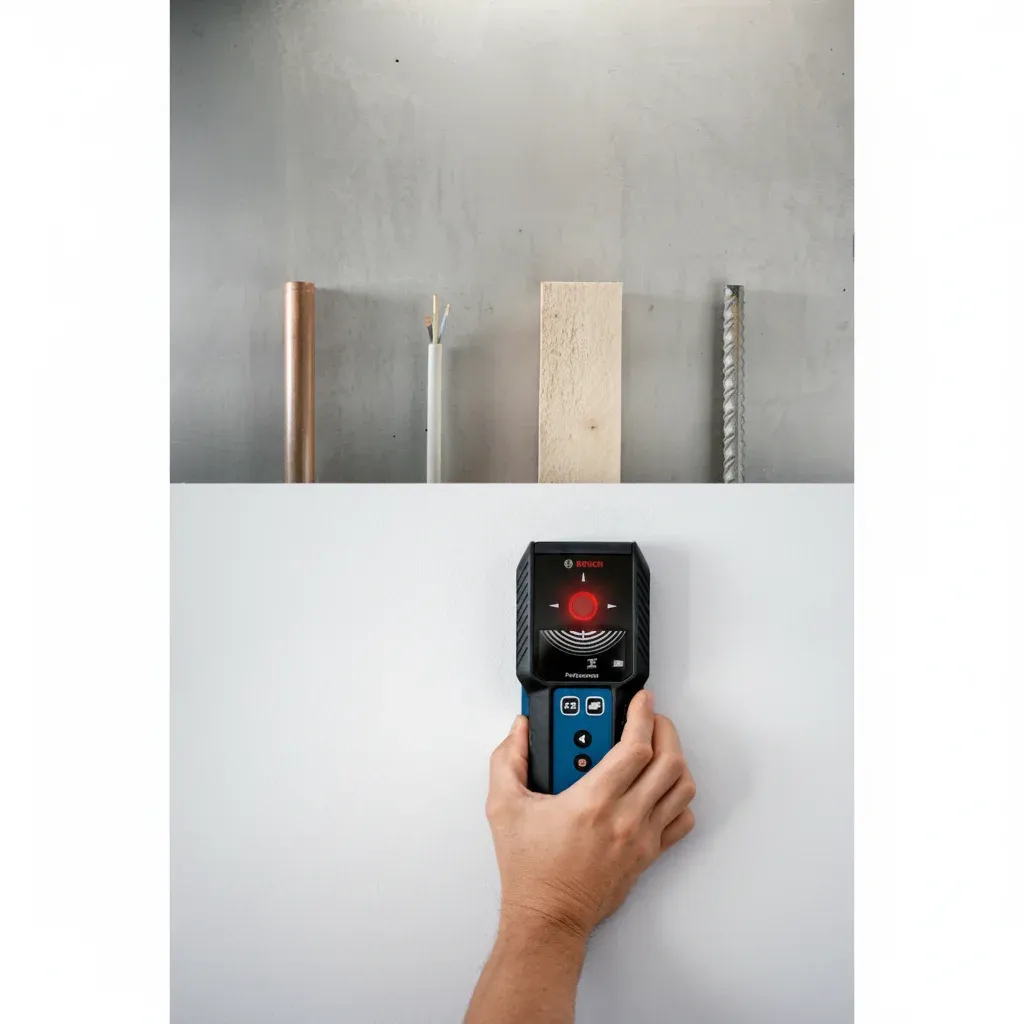
TL;DR: A wall stud detector is a handheld tool that helps you find timber studs, metal, pipes and live cables behind walls before drilling. In UK homes, this matters because wall types vary widely, from plasterboard stud walls to dot-and-dab over masonry. Based on our testing, the most useful models offer clear calibration, separate scan modes and consistent readings across different surfaces.
Key Takeaways
- A wall stud detector helps you find timber studs, hidden metal pipes and live electrical cables before drilling into a wall.
- In UK homes, wall construction varies widely, from plasterboard stud walls to solid masonry with dot-and-dab plasterboard, so the right detector matters.
- Good models offer separate modes for wood, metal and live wire detection, clear calibration, and reliable depth indication.
- No scanner should be treated as infallible; safe drilling still means checking cable zones and confirming findings carefully.
- If you want a broader overview before buying, see The Ultimate Guide to Stud Detector in the UK.
A wall stud detector is used to locate studs, hidden pipes and live electrical cables behind a wall so you can drill more safely and fix into a secure point. In practical terms, it reduces the risk of hitting concealed services or choosing a weak fixing position when putting up shelves, televisions, cabinets or grab rails.
However, that matters even more in Britain because our walls are not all built the same way. A Victorian terrace, a 1930s semi, a post-war flat and a new-build timber frame property can all behave differently behind the surface. Plasterboard on timber studs, metal framing, dot-and-dab adhesive dabs over masonry and concealed electrical runs all create scanning challenges that cheaper devices often struggle with.
Wallscan’s core promise is straightforward: The Ultimate Wall Scanner & Wall Stud Detector. The aim is practical rather than gimmicky — detect wood studs, hidden metal pipes and live electrical wires with pinpoint Bosch accuracy so you can drill with more confidence and less risk. This guide explains what a wall stud detector does, how it works, what UK buyers should look for and how to use one properly.
If you are comparing similar tool categories, you may also find it useful to read Wall Stud Finder Explained: A UK Buyer's Guide and Stud Wall Detector Explained: A UK Buyer's Guide.
What is a wall stud detector?
A wall stud detector is a handheld scanning tool designed to identify structural members and hidden services behind a finished wall surface. Depending on the model, it can detect:
- Timber studs behind plasterboard
- Metal studs or brackets
- Copper or steel pipes
- Live AC electrical cables
The best units do more than find the edge of a stud. Instead, they help build a clearer picture of what sits behind the surface so you can decide whether your chosen fixing point is safe and strong enough for the load.
This is especially useful in UK homes where many people assume every internal wall will behave like standard timber studwork. Often it will not. Dot-and-dab plasterboard fixed over blockwork can leave voids that confuse basic detectors. Likewise, metal corner beads, foil-backed insulation boards and closely spaced services can all affect readings.
Why do you need a wall stud detector in UK homes?
The main reason is safety. Drilling blind is never good practice when there could be concealed cables or pipework directly behind the plaster. According to UK home safety guidance and common trade practice, checking what sits behind the surface before drilling is one of the simplest ways to reduce avoidable damage and risk.
Electrical safety matters just as much. In England and Wales, electrical work in dwellings is governed in part by Part P of the Building Regulations. While not every small fixing job falls under notifiable work, damaging concealed wiring can still create shock and fire risks. Therefore, a detector will not replace competent judgement or electrical knowledge, but it gives you an essential first check before drilling.
There is also the cost angle. Even modest call-out repairs for damaged pipework or electrics can quickly run into triple figures once labour and making-good are included. So one accurate scan before drilling is far cheaper than repairing a punctured pipe behind fresh paint.
Based on our testing across common UK wall types, reliable detection becomes most important when walls contain mixed materials such as plasterboard over masonry or modern partitions with metal framing.
How does a wall stud detector work?
How does it detect timber studs?
Many wall stud detectors sense changes in density behind the wall surface. As you move across plasterboard, the tool looks for transitions from hollow cavity to denser material such as timber or metal framing. As a result, better units can identify edges more consistently and help estimate the centre point of the stud for stronger fixings.
Can it detect metal pipes and framing?
A separate mode often detects ferrous and non-ferrous metals hidden behind plaster or board. This helps locate copper pipes, steel conduits, screws into framing and metal studs. In many British renovation jobs this mode becomes just as important as wood mode because modern partitions may use metal framework rather than timber.
Can it detect live electrical cables?
A live wire mode looks for active AC electrical fields within certain depth limits. This can be valuable when checking likely cable routes above sockets, below switches or across accessory runs in recognised safe zones. Even so, it should always be treated as an aid rather than proof that an area contains no wiring if no alert appears.
Why is calibration important on a wall stud detector?
A good wall stud detector relies on correct calibration against the surface being scanned. If calibration starts over a stud, pipe or unusually dense patch of wall, results may be inaccurate from the outset. Consequently, quality devices make this process clearer with intuitive prompts and stable readings rather than vague signals that change on every pass.
Based on our testing, poor calibration is one of the biggest reasons users think their scanner is faulty when the real issue is simply where they started the scan.
Ready to drill safely with {brand_name}?
Shop Now — £175.47